Preserving a genetic heritage
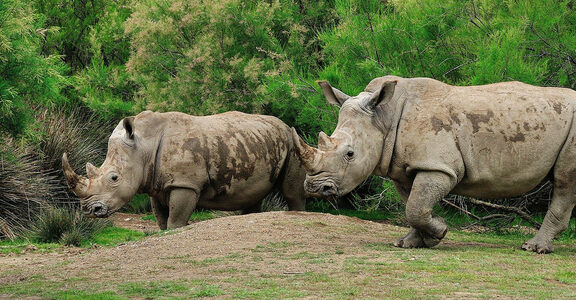
Wildlife is experiencing an unprecedented crisis at the start of the 21st century. Some species that were still abundant 20 or 30 years ago (giraffe, lion, African wild dog, Gabon grey parrot…) or that were thought to have been saved by 20th century conservation efforts (white rhinoceros, cheetah…) have recently had the sad privilege of having their great precariousness made official by the IUCN (International Union for Conservation of Nature), at its last congress in September 2016.
For a variety of reasons, the most pessimistic scenarios are becoming reality, and many species seem doomed to disappear in the coming decades. The African continent is particularly at risk because poaching is widespread, civil wars are permanent and millions of hectares of savannahs, wetlands and forests are being converted to farmland.
This gloomy picture highlights the responsibility that animal parks bear today. For some species that have disappeared from their natural habitat, wildlife parks are the only hope of one day returning to the environment they should never have left. Ensuring the sustainability of captive wild animal populations has therefore become essential.


Since the 80s and 90s, the world’s major animal parks have been working together to avoid the pitfalls of inbreeding and to decide which species should be bred first.
The parks that are most sensitive to this conservation action have formed associations (EAZA for Europe, AZA for North America, etc.), and each of these associations has organized itself to define the countless actions to be carried out by its members to ensure that the captive wild animal population as a whole can be maintained in the long term, without the need to include new specimens from the wild. To this end, they have appointed a coordinator for each of the species benefiting from the highest level of management: Breeding Programs (EEP) and Studbooks (ESB). This coordinator has all the genealogical information for the species he/she is responsible for, and once a year he/she gives breeding instructions for the coming year to the various members throughout Europe.
This sometimes means having to part with a precious animal because a genetically compatible partner lives several thousand kilometers away. To remain members of the EAZA, animal parks must abide by these recommendations and never give a market value to the animals they dispose of. All this is done in the interest of the species and without any financial compensation.
The Réserve Africaine de Sigean participates in the following 54 breeding programs:
Mammals
| Species | IUCN status | Coordinator |
| Barbary Macaque, Macaca sylvanus | EN – Endangered (2016) | Iñaki Ezquerro (Barcelona Zoo, Spain) |
| Lar gibbon, Hylobates lar | EN – Endangered (2015) | Job Stumpel (Emmen, Netherlands) |
| Chimpanzee, Pan troglodytes | EN – Endangered (2016) | Jana Pluhácková (Ostrava Zoo, Czech Republic) |
| Geoffroy’s Tufted-ear Marmoset, Callithrix geoffroyi | LC – Least Concern (2015) | Agustin Lopez Goya (Madrid Faunia, Spain) |
| Northern Talapoin monkey, Miopithecus ogouensis | NT – Near Threatened (2017) | Jesús Recuero (Bioparc Fuengirola, Spain) |
| Black capped squirrel monkey, Saimiri boliviensis | LC – Least Concern (2020) | Adrian Baumeyer (Zoo Basel, Switzerland) |
| African Wild Dog, Lycaon pictus | EN – Endangered (2012) | Gabriela Linhart (Zoo Dvůr Králové, Czech Republic) |
| Asiatic black bear, Ursus thibetanus | VU – Vulnerable (2016) | Katarzyna Dybalska (Warsaw Zoo, Poland) |
| Cheetah, Acinonyx j.jubatus | VU – Vulnerable (2014) | Lars Versteege (Hilvarenbeek, Netherlands) |
| North African lion, Panthera leo | VU – Vulnerable (2014) | Jon Merrington (Longleat Safaripark, United Kingdom) |
| Somali wild ass, Equus africanus | CR – Critically Endangered (2016) | Beatrice Steck (Zoo Basel, Switzerland) |
| Grevy’s zebra, Equus grevyi | EN – Endangered (2016) | Tanya Langenhorst (Marwell, United Kingdom) |
| Mountain zebra, Equus zebra hartmannae | VU – Vulnerable (2017) | Marianne de Jesús (Réserve Africaine de Sigean, France) |
| Onager, Equus hemionus onager | EN – Endangered (2015) | Adriane Prahl (Tierpark Hagenbeck, Germany) |
| White rhinoceros, Ceratotherium simum | NT – Near Threatened (2020) | Lars Versteege (Hilvarenbeek, Netherlands) |
| Common warthog, Phacochoerus africanus | LC – Least Concern (2016) | Ross Snipp (Flamingo Land, United Kingdom) |
| Red buffalo, Syncerus caffer nanus | NT – Near Threatened (2018) | Merel Zimmermann (Netherlands) |
| Reticulated giraffe and kordofan, Giraffa v. reticulata et antiquorum | CR – Critically Endangered (2018) | Jörg Jebram (Opel Zoo, Germany) |
| Blesbok, Damaliscus pygargus phillipsi | LC – Least Concern (2014) | Sam Whitbread (Chessington, United Kingdom) |
| Cuvier’s gazelle, Gazella cuvieri | VU – Vulnerable (2016) | Eulalia Moreno (Almeria, Spain) |
| Nyala, Tragelaphus angasii | LC – Least Concern (2016) | Susana Nolasco (Lisboa Zoo, Portugal) |
| Sitatunga, Tragelaphus s. gratus | LC – Least Concern (2016) | Peter Zwanger (Koln, Germany) |
| Greater Kudu, Tragelaphus strepsiceros | LC – Least Concern (2016) | Claudia Terwort (Germany) |
| Roan antelope, Hippotragus equinus | LC – Least Concern (2016) | Marlis Dumke (Hannover, Germany) |
| Sable antelope, Hippotragus n. niger | LC – Least Concern (2016) | Kim Skalborg Simonsen (Givsuk Zoo, Denmark) |
| Nile lechwe, Kobus megaceros | EN – Endangered (2016) | Yitzhak Yadid (Bioparco di Roma, Italy) |
| Aoudad, Ammotragus lervia sahariensis | VU – Vulnerable (2020) | Jorge Cassinello (Estación Experimental de Zonas Áridas, Spain) |
| Lechwe, Kobus leche | NT – Near Threatened (2016) | John MCLaughlin (Fota Wildlife Park, Ireland) |
| Impala, Aepyceros melampus | LC – Least Concern (2008) | Stefan Reegen (Zoo Zürich, Switzerland) |
| Red river hog, Potamochoerus porcus | LC – Least Concern (1996) | Janina Dötzer (Aachener Tierpark, Germany) |
| Meerkat, Suricata suricatta | LC – Least Concern (1996) | Jessie Boylan (Paradise Wildlife Park, United Kingdom) |
Birds
| Species | IUCN status | Coordinator |
| Red-necked ostrich, Struthio c.camelus | LC – Least Concern (2018) | Maren Frerking (Zoo Hannover, Germany) |
| Goliath heron, Ardea goliath | LC – Least Concern (2016) | Michal Podhrazsky (Safari Park Dvůr Králové, Czech Republic) |
| Hamerkop, Scopus umbretta | LC – Least Concern (2016) | Maisy Skinner (Flamingo Land, UK) |
| Yellow-bird stork, Mycteria ibis | LC – Least Concern (2016) | Roman Horsky (Zoo Zlin, Czech Republic) |
| Abdim’s stork, Ciconia abdimii | LC – Least Concern (2016) | Zuzana Boumrah (London Zoo, United Kingdom) |
| Marabou stork, Leptopilos crumeniferus | LC – Least Concern (2016) | Cathy King (Walsrode, Netherlands) |
| Northern bald ibis, Geronticus eremita | EN – Endangered (2018) | Juliane Pokorny (Alpenzoo, Austria) |
| Pink-backed pelican, Pelecanus rufescens | LC – Least Concern (2016) | Ryan Berry (Longleat Safari Park, United Kingdom) |
| Saddle-billed stork, Ephippiorhynchus senegalensis | NT – Near Threatened (2024) | Matthias Hendel (Dresden Zoo, Germany) |
| Blue-bellied roller, Coracias cyanogaster | LC – Least Concern (2024) | Luke Forster (Blackpool Zoo, United Kingdom) |
| Lilac-breasted roller, Coracias caudatus | LC – Least Concern (2024) | Luke Forster (Blackpool Zoo, United Kingdom) |
| Rüppell’s vulture, Gyps rueppelli | CR – Critically Endangered (2021) | Maarten Vis (Rotterdam Zoo, Netherlands) |
| Hooded vulture, Necrosyrtes monachus | CR – Critically Endangered (2021) | Holly Cale (London Zoo, United Kingdom) |
| White-headed vulture, Trigonoceps occipitalis | CR – Critically Endangered (2021) | Joost Lammers (Vogelpark Avifauna, Netherlands) |
| Black-crowned crane, Balearica pavonina | VU – Vulnerable (2016) | Lauren Hough (Chester Zoo, United Kingdom) |
| Demoiselle crane, Anthropoides virgo | LC – Least Concern (2018) | Marcin Chrapowicki (Warsaw Zoological Garden, Poland) |
| Grey parrot, Psittacus erithacus | EN – Endangered (2020) | Aude Haelewyn-Desmoulins (Parrot World, France) |
| Timneh parrot, Psittacus timneh | EN – Endangered (2020) | Aude Haelewyn-Desmoulins (Parrot World, France) |
| Violet turaco, Musophaga violacea | NT – Near Threatened (2025) | Andrzej Kruszewicz (Warsaw Zoological Garden, Poland) |
| Red-crested turaco, Tauraco erythrolophus | LC – Least Concern (2016) | Louise Peat (Burford, United Kingdom) |
| White-headed duck, Oxyura leucocephalaus | EN – Endangered (2017) | Heiko Janatzek (Zoom Erlebniswelt Gelsenkirchen, Germany) |
Reptiles
| Species | IUCN status | Coordinator |
| Dwarf crocodile, Osteolamus tetraspis | VU – Vulnerable (1996) | Franziska Anni Franke (Leipzig Zoo, Germany) |
| West African Slender-snout Crocodile, Mecistops cataphractus | CR – Critically Endangered (2013) | François Huyghe (Biotropica, France) |